Tower of Flint
"Over their irregular roofs would fall throughout the seasons, the shadows of time-eaten buttresses, of broken and lofty turrets, and, most enormous of all, the shadow of the Tower of Flints. This tower, patched unevenly with black ivy, arose like a mutilated finger from among the fists of knuckled masonry and pointed blasphemously at heaven. At night the owls made of it an echoing throat; by day it stood voiceless and cast its long shadow."
Fuchsia's attic
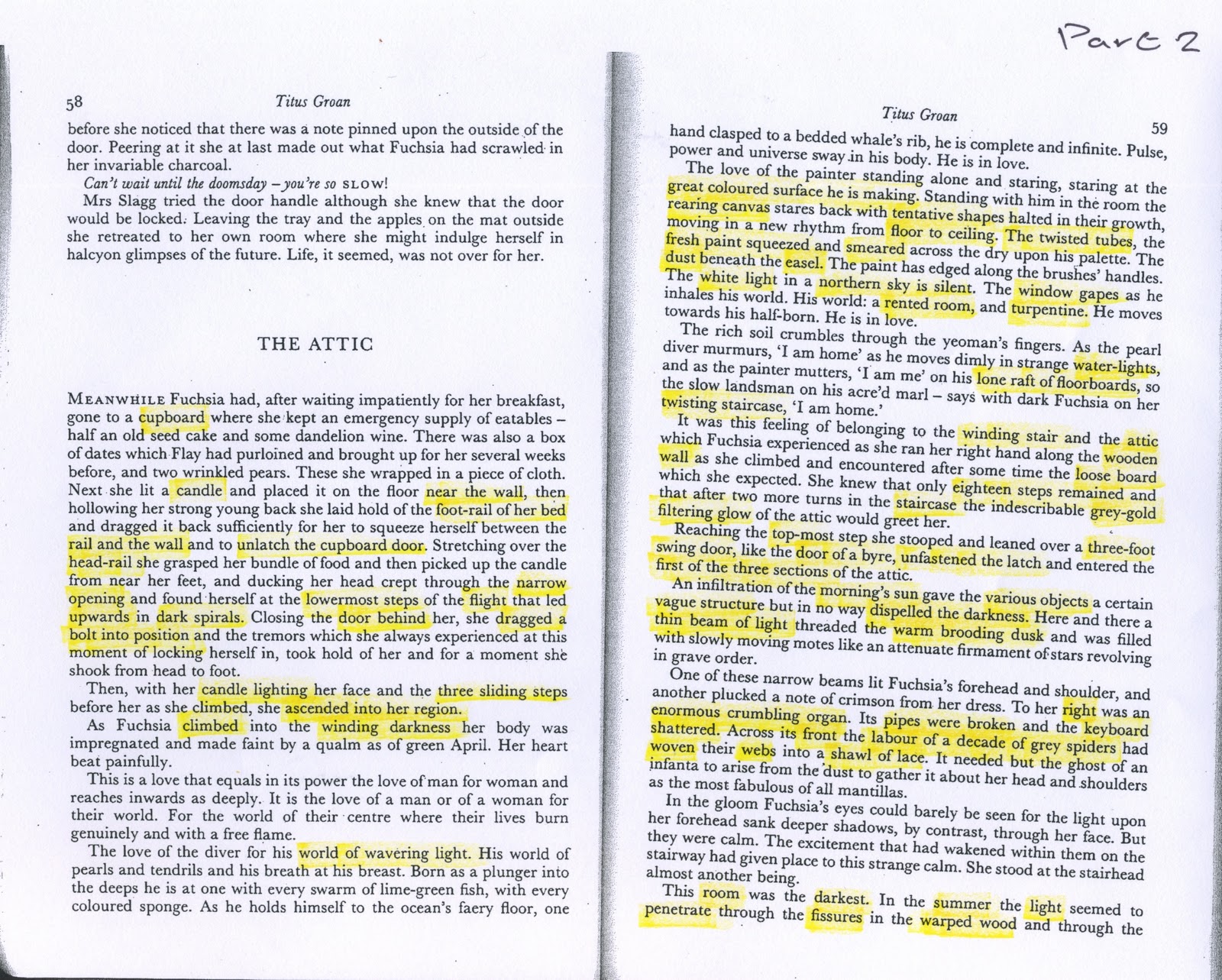
Split in three rooms; the lumber room, the acting room and the 'secret attic'. The lumber room is filled with clutter, junk and the most iconic piece from this room is a broken piano. The acting is a very open, spacious room in which Fuchsia imagines characters to occupy the space. The 'secret attic' is where Fuchsia sleeps and keeps her most treasured items. She can also look out onto the city from the window.
The Hall Of Bright Carvings
This is where the top three pieces of work (sculptures) are put on display. It is quite dark as the occupier keeps the shutters down. It also has an emerald piece, that would appear to be the main object of interest. The sculptures are of wood. The hall itself is very large in size, as would need be with all of the art of the city contained inside.
The Room Of Roots
A room consisting of "a thousand branching, writhing, coiling, intertwining, diverging, converging, interlacing limb" like branches. The stems thickened at a converging tall, narrow aperture on the far side of the room. The upper half has a pouring grey, amorphous light. It is described as a "labyrinth", "writhing maze" and a network of weird arms that rose and fell, dipped and clawed, motionless yet alive with serpentine rhythms.
This room is described, at first, as a room infested by plants with roots dominating the interior. However, the room is later reinforced to be a giant painting with immaculate detail. The giant painting also is strangely coloured.
The Great Kitchen
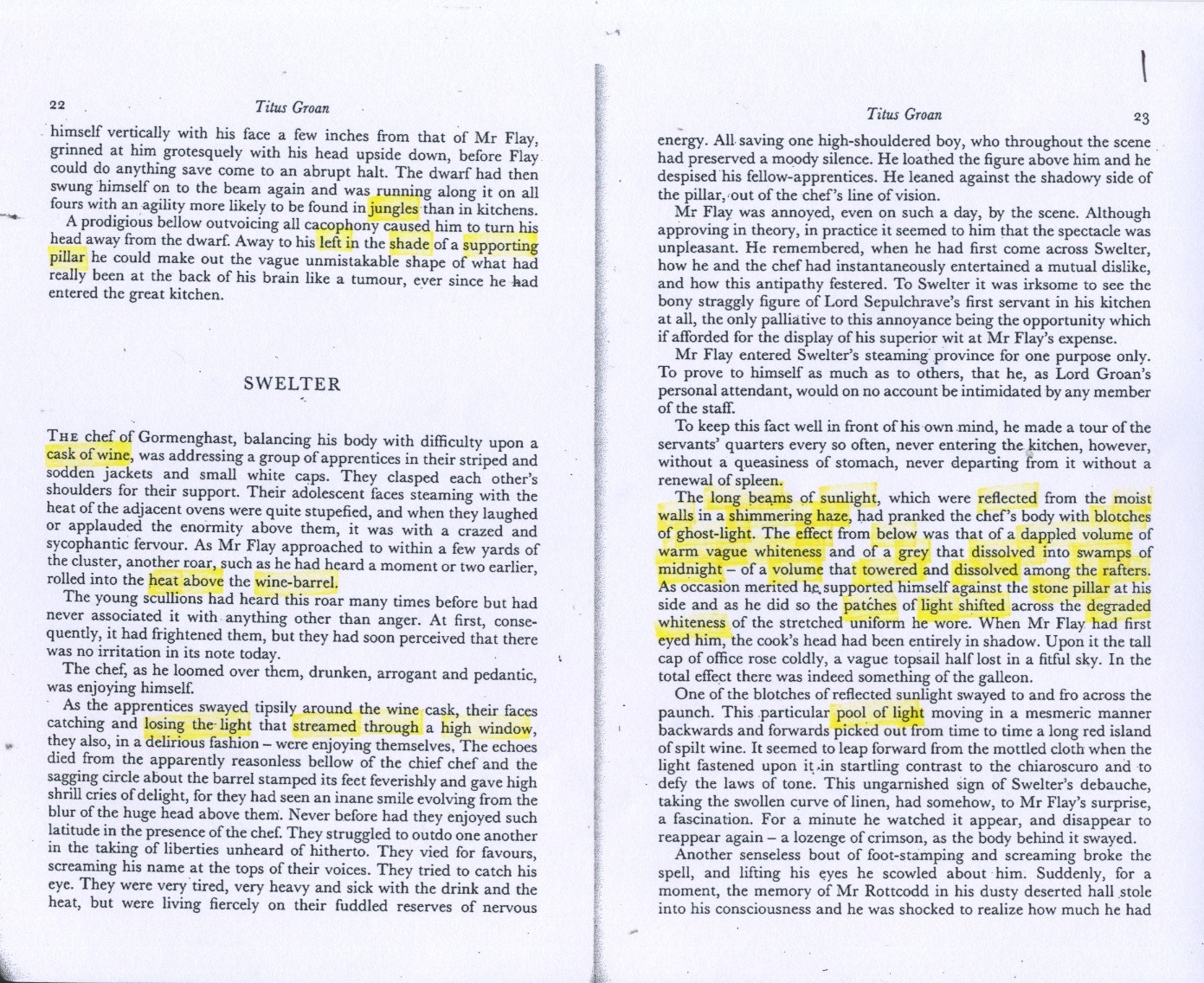
The Great Kitchen, is a part of the kitchen quarters that also contains the slaughter-house, the bakeries, the wine vaults and the underground network of the castle cellars. The Great Kitchen has a steaming, airless concentration, giving a sickening atmosphere that is only intensified by the sun's rays streaming through the high windows. The fires of the ovens, raging with the festivities, left the walls with moisture, that were built of grey slabs of stone. The Great Kitchen undergoes a constant flux of shifting figures with the momentary chaos .
 |
| Gormenghast, Titus Groan |
For this new unit, Space, I had chosen, at random, folder 6 which contained The Gormenghast Novels by Mervyn Peake made in 1946.
Not knowing anything about this, I read up the plot of the story. The series of novels follow Titus through his life and his relationship to the castle, Gormenghast, detailed in four books; Titus Groan, Gormenghast, Boy In The Darkness (though the castle is never named) and Titus Alone. There were two other books planned, Titus Awakes and Gormenghast Revisted, but due to Parkinson's disease Mervyn passed away only ever writing a few hundred words.
Whilst the story has two protagonists, Titus Groan and Steerpike, the novels also explore the lives of the denizens of the castle.
The selected book from the series given is Titus Groan, the first entry.
Upon reading the selected sections given, there are a number of well described places. The Hall of The Bright Carvings, features wooden sculptures that the craftsmen, of the extremely large city, create for a festival. The light entering and reflecting off of these sculptures would be a great example for colour, consisting mainly yellows, oranges and reds giving a warm feeling yet a cold loneliness to the occupant.
The Great Kitchen would be another prime choice, giving yet another warm feeling and chaotic mood when in motion. The environment can be perceived in two ways. The first being a calm, clean and static as it is first imagined to be in the book. Then as it becomes occupied, it becomes drenched in the fires on the ovens, stained with food, making it feel animated, with the shadows in motion.
The next location is The Attic. This one location is divided into three sections, all of which are occupied by the mind and memories of Fuchsia. The first of three, is the lumber room which isn't as useless at it sounds. It contains worn out furniture, a broken piano, hundreds of pictures, with a centred light giving a vague image of the dark room. The second is the acting room, which has quite a dark, gloomy presence about it, occupied by five imaginary figures conjured by Fuchsia's mind. Past this room, is the balcony with an overview of the city, which is in itself another location. Then finally the 'secret attic'. It is here where her most wild and self-contained thoughts are apparent. There is a window, from which she observes others and her paranoia grows the most. Though the downside to this room is that it is bare of detail and fascination.
The last is The Room of Roots. At first, this room is depicted as an ivory infestation covering every inch of the enormous room with demonic hand-like branches, to only later be described as a painting. A colourful one at that. With that in mind, I could depict it as I first imagined it to be or how the author later reinforced it to be.
Either way, this seems like an excellent novel and I look forward to expressing my imagination of the world.